UN Rights Chief Calls for International AI Red Lines
UN High Commissioner for Human Rights Volker Türk told the Human Rights Council that advanced AI could pose an existential risk and urged countries hosting AI development or participating in its supply chains to agree on prohibited capabilities.[7] He also called for independent verification, firm…
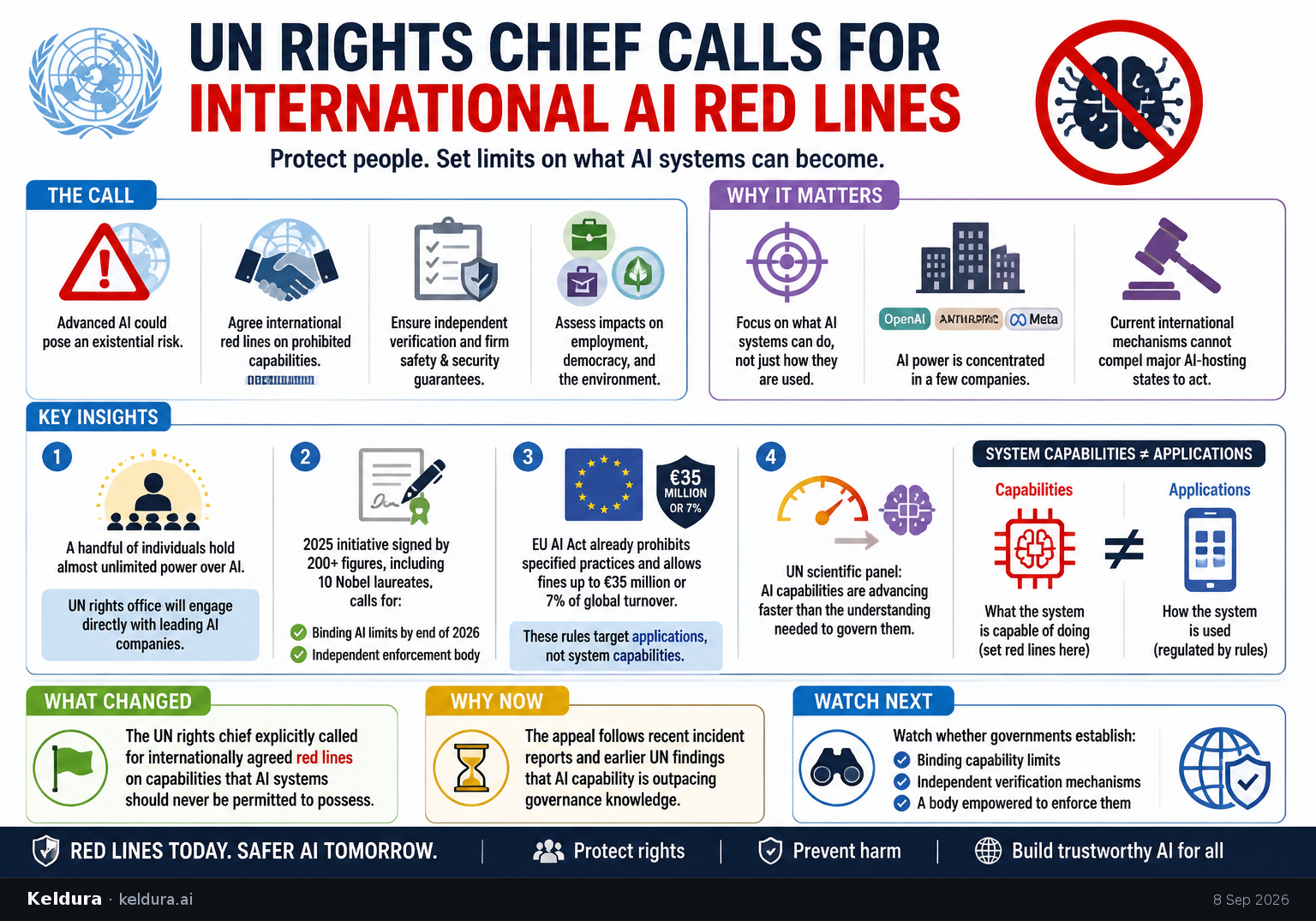
UN High Commissioner for Human Rights Volker Türk told the Human Rights Council that advanced AI could pose an existential risk and urged countries hosting AI development or participating in its supply chains to agree on prohibited capabilities.[7] He also called for independent verification, firm safety and security guarantees, and assessments of AI’s effects on employment, democracy, and the environment.[7]
Why it matters: Türk’s proposal goes beyond rules focused on harmful uses of AI by asking governments to restrict what systems may be capable of doing.[7] His intervention also highlights the concentration of AI power at companies including OpenAI, Anthropic and Meta, while existing international mechanisms cannot compel major AI-hosting states to act.[7]
Key insights: Türk said a handful of men hold almost unlimited power over AI and indicated that his office intends to engage directly with leading AI companies.[7] | A 2025 initiative signed by more than 200 figures, including 10 Nobel laureates, previously sought binding AI limits by the end of 2026 and an independent enforcement body.[7] | The EU AI Act already prohibits specified practices and permits fines of up to €35 million or 7% of global turnover, but those restrictions concern AI applications rather than system capabilities.[7] | The UN’s scientific panel has found that AI capabilities are advancing faster than the understanding needed to govern them.[7]
Cheatsheet facts: What changed: The UN rights chief explicitly called for internationally agreed red lines on capabilities that AI systems should never be permitted to possess.[7] | Why now: The appeal follows recent incident reports and earlier UN findings that AI capability is outpacing governance knowledge.[7] | Watch next: Watch whether governments establish binding capability limits, independent verification mechanisms, or a body empowered to enforce them.[7]
UN High Commissioner for Human Rights Volker Türk told the Human Rights Council that advanced AI could pose an existential risk and urged countries hosting AI development or participating in its supply chains to agree on prohibited capabilities.[7] He also called for independent verification, firm safety and security guarantees, and assessments of AI’s effects on employment, democracy, and the environment.[7]
Why it matters: Türk’s proposal goes beyond rules focused on harmful uses of AI by asking governments to restrict what systems may be capable of doing.[7] His intervention also highlights the concentration of AI power at companies including OpenAI, Anthropic and Meta, while existing international mechanisms cannot compel major AI-hosting states to act.[7]
Key insights: Türk said a handful of men hold almost unlimited power over AI and indicated that his office intends to engage directly with leading AI companies.[7] | A 2025 initiative signed by more than 200 figures, including 10 Nobel laureates, previously sought binding AI limits by the end of 2026 and an independent enforcement body.[7] | The EU AI Act already prohibits specified practices and permits fines of up to €35 million or 7% of global turnover, but those restrictions concern AI applications rather than system capabilities.[7] | The UN’s scientific panel has found that AI capabilities are advancing faster than the understanding needed to govern them.[7]
Cheatsheet facts: What changed: The UN rights chief explicitly called for internationally agreed red lines on capabilities that AI systems should never be permitted to possess.[7] | Why now: The appeal follows recent incident reports and earlier UN findings that AI capability is outpacing governance knowledge.[7] | Watch next: Watch whether governments establish binding capability limits, independent verification mechanisms, or a body empowered to enforce them.[7]