Three face charges over alleged $129 million AI impersonation scheme
Prosecutors say AI impersonations helped steal about $129 million, but how did companies distinguish real authority from a fake?
On November 5, prosecutors said three people had been indicted in New York over an alleged AI impersonation scheme that stole about $129 million.
Jacob Soall, 41, Sharon Hazan, 54, and Guy Sheetrit, 42, were indicted on wire-fraud and aggravated-identity-theft charges, prosecutors said Thursday. The indictment alleges that they used AI to impersonate corporate executives and attorneys while targeting thousands of companies worldwide over mor…
Open original · [3] 3 charged in scheme to use AI to impersonate CEOs and attorneys to steal $129 million — apnews.com
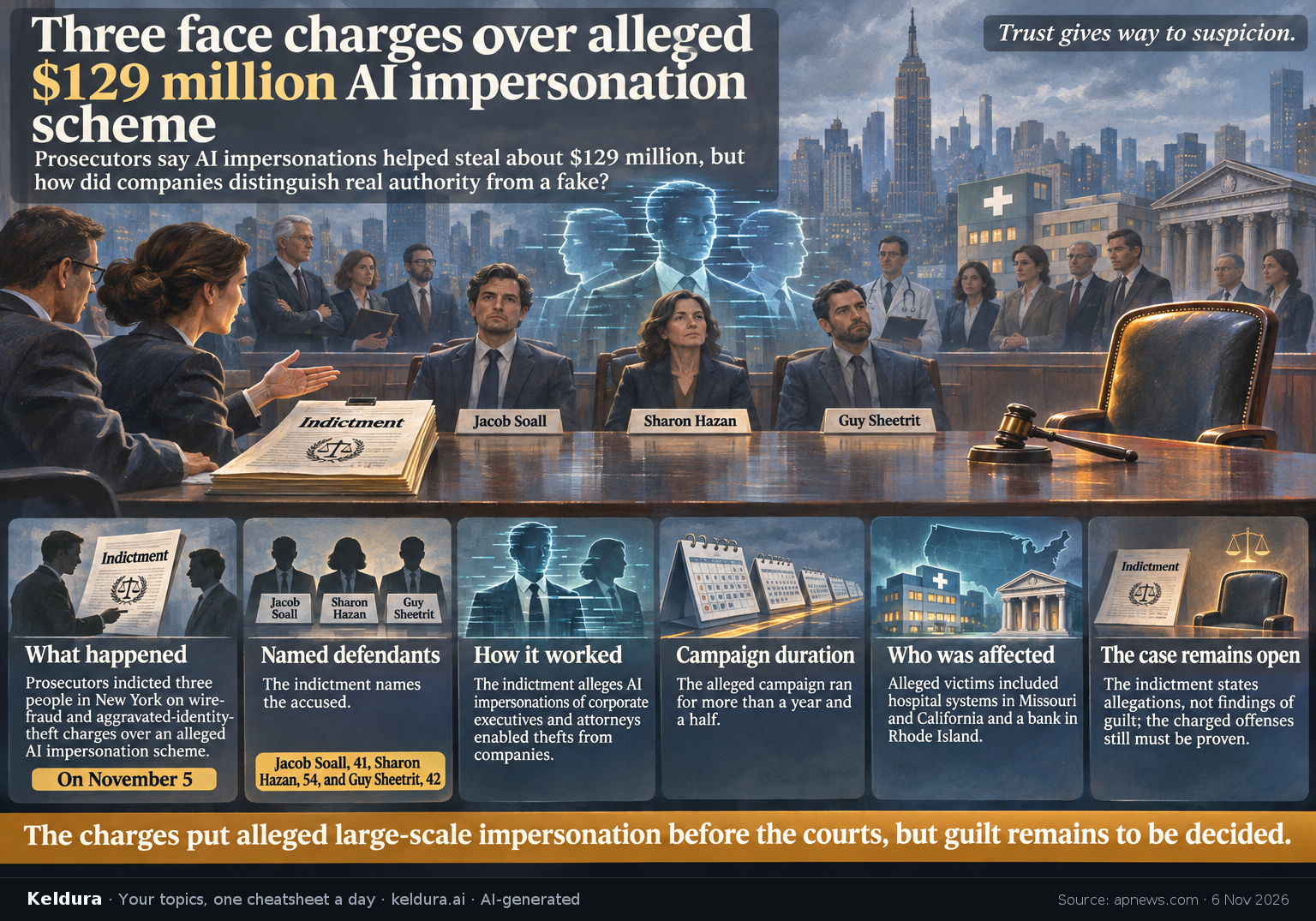
Jacob Soall, 41, Sharon Hazan, 54, and Guy Sheetrit, 42, were indicted on wire-fraud and aggravated-identity-theft charges, prosecutors said Thursday. The indictment alleges that they used AI to impersonate corporate executives and attorneys while targeting thousands of companies worldwide over more than a year and a half. [3]
Why it matters: The alleged victims included hospital systems in Missouri and California and a bank in Rhode Island, putting the consequences beyond technology companies. The approximately $129 million allegedly stolen shows the financial exposure when convincing impersonations reach organizations handling large payments. [3]
Key insights: The alleged operation targeted thousands of companies worldwide, rather than a single employer or industry. [3] | Prosecutors allege impersonation of both executives and attorneys, combining two forms of professional authority in the scheme. [3]
Cheatsheet facts: What happened: Three people were indicted on wire-fraud and aggravated-identity-theft charges over an alleged AI-enabled theft scheme. [3] | Why: The indictment alleges that AI was used to impersonate executives and attorneys while targeting thousands of companies. [3] | Who pays: Prosecutors put the alleged theft at about $129 million; victims included hospital systems and a bank. [3] | What we don't know: What verification steps did the affected organizations use before transferring money to the alleged impersonators? [3]