Kyiv faces record alerts as US envoys revive peace efforts
Kyiv is experiencing more daily air-raid alerts than at any point since Russia’s full-scale invasion, averaging 10 a day since round-the-clock attacks began at the end of August.[2] US envoys Steve Witkoff and Jared Kushner brought proposals described by a senior Ukrainian official as “more effecti…
Kyiv is experiencing more daily air-raid alerts than at any point since Russia’s full-scale invasion, averaging 10 a day since round-the-clock attacks began at the end of August.[2] US envoys Steve Witkoff and Jared Kushner brought proposals described by a senior Ukrainian official as “more effective,” but their talks with President Volodymyr Zelensky produced no announced breakthrough.[8]
Why it matters: Russia’s daytime strikes and faster drones are disrupting schools, businesses and transport while testing Ukraine’s air defences; the simultaneous diplomatic activity has yet to produce an agreement as Zelensky warns that fighting appears likely to continue into winter.[2][8]
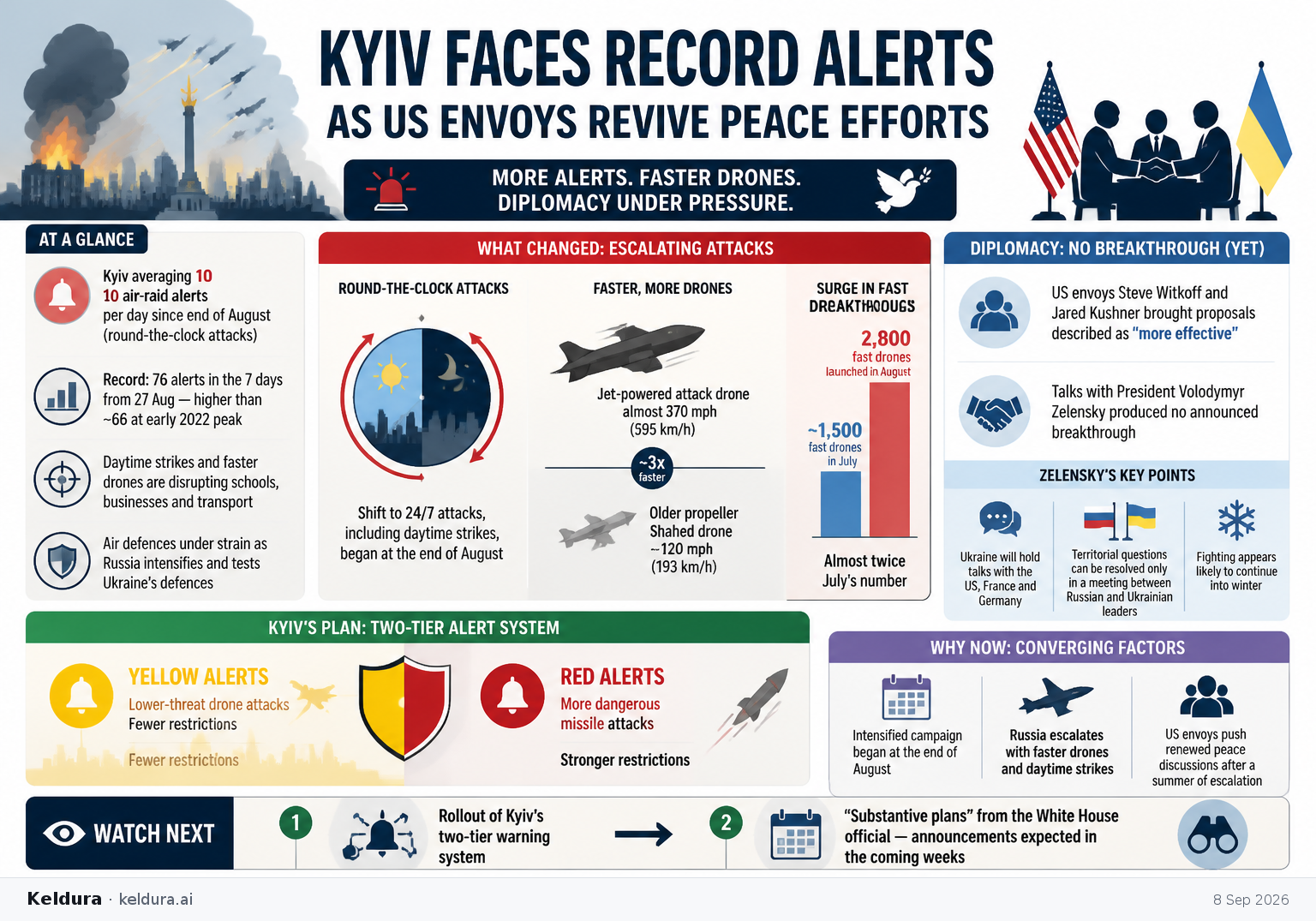
Key insights: Kyiv recorded 76 air-raid alerts in the seven days from 27 August, exceeding a comparable peak of about 66 during the week beginning 27 February 2022.[2] | New jet-powered attack drones can fly at almost 370 mph (595 km/h), around three times the speed of older propeller-driven Shahed drones; Ukraine says Russia launched 2,800 fast drones in August, almost twice July’s number.[2] | Ukraine plans a two-tier alert system: yellow warnings for lower-threat drone attacks with fewer restrictions and red warnings for more dangerous missile attacks.[2] | Zelensky said Ukraine would hold talks with the US, France and Germany and reiterated that territorial questions could be resolved only through a meeting between the Russian and Ukrainian leaders.[8]
Cheatsheet facts: What changed: Russia shifted toward round-the-clock attacks on Kyiv, including daytime strikes and increased use of faster jet-powered drones.[2] | Why now: The intensified campaign began at the end of August as US envoys pursued renewed settlement discussions after a summer of escalation.[2][8] | Watch next: Watch for the rollout of Kyiv’s two-tier warning system and the “substantive plans” that a White House official said would be announced in the coming weeks.[2][8]
Kyiv is experiencing more daily air-raid alerts than at any point since Russia’s full-scale invasion, averaging 10 a day since round-the-clock attacks began at the end of August.[2] US envoys Steve Witkoff and Jared Kushner brought proposals described by a senior Ukrainian official as “more effective,” but their talks with President Volodymyr Zelensky produced no announced breakthrough.[8]
Why it matters: Russia’s daytime strikes and faster drones are disrupting schools, businesses and transport while testing Ukraine’s air defences; the simultaneous diplomatic activity has yet to produce an agreement as Zelensky warns that fighting appears likely to continue into winter.[2][8]
Key insights: Kyiv recorded 76 air-raid alerts in the seven days from 27 August, exceeding a comparable peak of about 66 during the week beginning 27 February 2022.[2] | New jet-powered attack drones can fly at almost 370 mph (595 km/h), around three times the speed of older propeller-driven Shahed drones; Ukraine says Russia launched 2,800 fast drones in August, almost twice July’s number.[2] | Ukraine plans a two-tier alert system: yellow warnings for lower-threat drone attacks with fewer restrictions and red warnings for more dangerous missile attacks.[2] | Zelensky said Ukraine would hold talks with the US, France and Germany and reiterated that territorial questions could be resolved only through a meeting between the Russian and Ukrainian leaders.[8]
Cheatsheet facts: What changed: Russia shifted toward round-the-clock attacks on Kyiv, including daytime strikes and increased use of faster jet-powered drones.[2] | Why now: The intensified campaign began at the end of August as US envoys pursued renewed settlement discussions after a summer of escalation.[2][8] | Watch next: Watch for the rollout of Kyiv’s two-tier warning system and the “substantive plans” that a White House official said would be announced in the coming weeks.[2][8]