Soft corals slump again in warming waters near Jeju
Divers and scientists report that soft corals around Jeju are again sagging, collapsing and dying after two years of rising temperatures and harsher weather.[7] Researchers first documented Jeju’s 2024 slumping event in a May Scientific Reports article and say the 2026 episode could worsen if high…
Divers and scientists report that soft corals around Jeju are again sagging, collapsing and dying after two years of rising temperatures and harsher weather.[7] Researchers first documented Jeju’s 2024 slumping event in a May Scientific Reports article and say the 2026 episode could worsen if high water temperatures persist through September.[7]
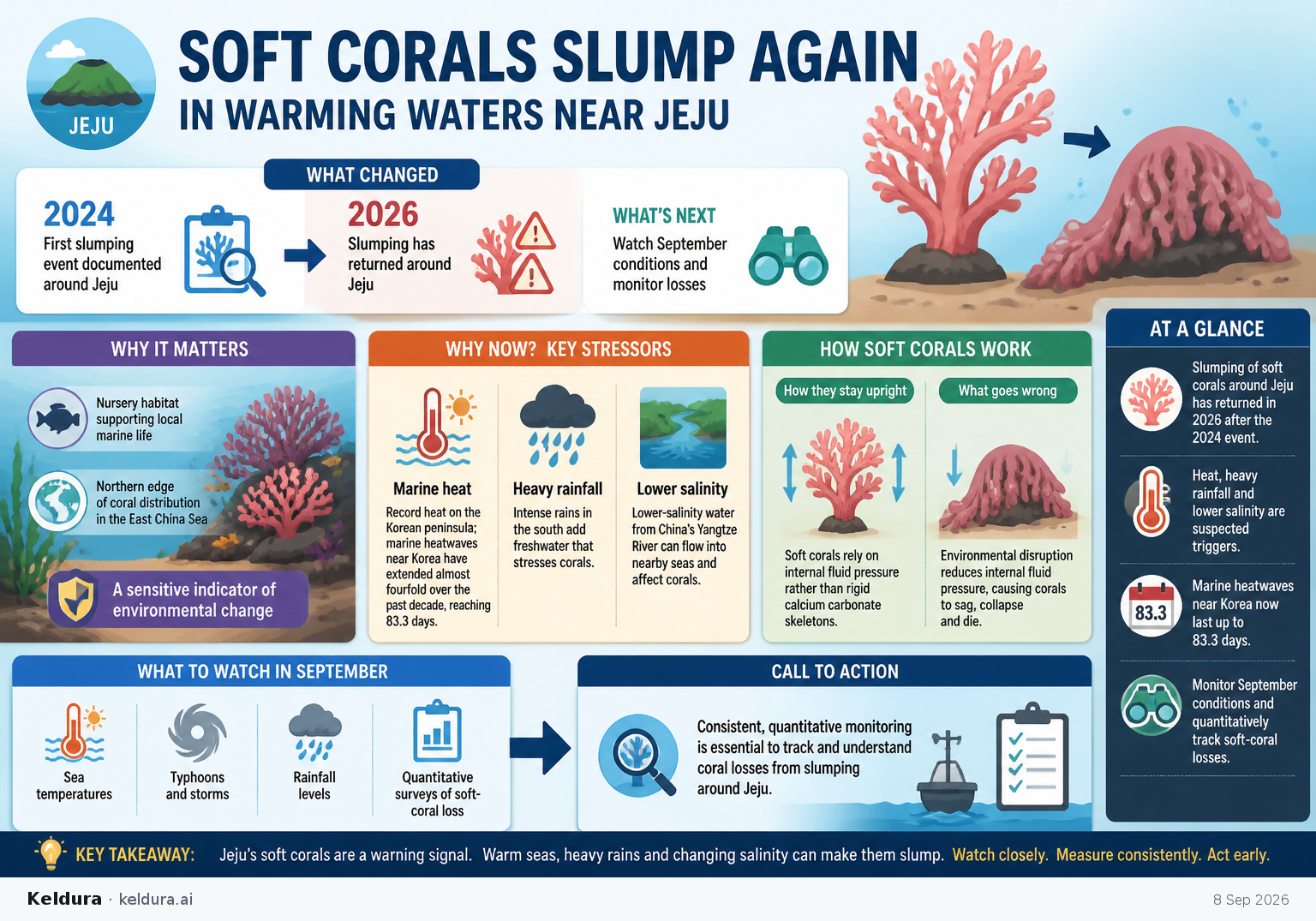
Why it matters: Jeju’s soft corals provide nursery habitat supporting the local marine ecosystem and occupy the northern edge of coral distribution in the East China Sea, making their condition a sensitive indicator of environmental change.[7]
Key insights: Soft corals depend on internal fluid pressure rather than rigid calcium carbonate skeletons, so environmental disruption can cause them to sag or collapse.[7] | Potential triggers include marine heat, heavy rainfall and lower-salinity water flowing from China’s Yangtze River.[7] | Marine heatwaves around Korea have extended almost fourfold over the past decade, reaching 83.3 days, according to weather authorities.[7] | Scientists are calling for consistent, quantitative monitoring of coral losses caused by slumping.[7]
Cheatsheet facts: What changed: The coral-slumping phenomenon documented in 2024 has returned around Jeju in 2026.[7] | Why now: Record heat on the Korean peninsula, heavy southern rains and changing salinity are among the suspected environmental stresses.[7] | Watch next: Monitor September sea temperatures, typhoons, rainfall and quantitative surveys of soft-coral loss around Jeju.[7]
Divers and scientists report that soft corals around Jeju are again sagging, collapsing and dying after two years of rising temperatures and harsher weather.[7] Researchers first documented Jeju’s 2024 slumping event in a May Scientific Reports article and say the 2026 episode could worsen if high water temperatures persist through September.[7]
Why it matters: Jeju’s soft corals provide nursery habitat supporting the local marine ecosystem and occupy the northern edge of coral distribution in the East China Sea, making their condition a sensitive indicator of environmental change.[7]
Key insights: Soft corals depend on internal fluid pressure rather than rigid calcium carbonate skeletons, so environmental disruption can cause them to sag or collapse.[7] | Potential triggers include marine heat, heavy rainfall and lower-salinity water flowing from China’s Yangtze River.[7] | Marine heatwaves around Korea have extended almost fourfold over the past decade, reaching 83.3 days, according to weather authorities.[7] | Scientists are calling for consistent, quantitative monitoring of coral losses caused by slumping.[7]
Cheatsheet facts: What changed: The coral-slumping phenomenon documented in 2024 has returned around Jeju in 2026.[7] | Why now: Record heat on the Korean peninsula, heavy southern rains and changing salinity are among the suspected environmental stresses.[7] | Watch next: Monitor September sea temperatures, typhoons, rainfall and quantitative surveys of soft-coral loss around Jeju.[7]