Climate pledges leave emissions cuts short of the 1.5°C pathway
Governments have promised emissions cuts, but how much warming would delivering those promises still leave?
On October 21, the UN's latest Emissions Gap Report said current national policies put the world on course for 2.8°C of warming this century.
Current national policies point to 2.8°C of warming by 2100, while delivering all climate promises would lower that projection to 2.1°C, according to the UN's latest assessment. [6] Its lowest-overshoot pathway requires emissions to fall 18% by 2030 from 2025 levels, compared with the 5–8% reductio…
Open original (4 sources):
- [6] UN says 1.5°C is over and world is on track for 2.8°C of global warming | New Scientist — newscientist.com
- [8] ‘Sobering’: Carbon emissions from oil, gas and coal continue to rise – The Irish Times — irishtimes.com
- [2] World must cut emissions by 18% in four years ‘to find our way back’, UN says | Climate crisis | The Guardian — theguardian.com
- [4] U.S. greenhouse gas emissions grew the most of any G20 country last year : NPR — npr.org
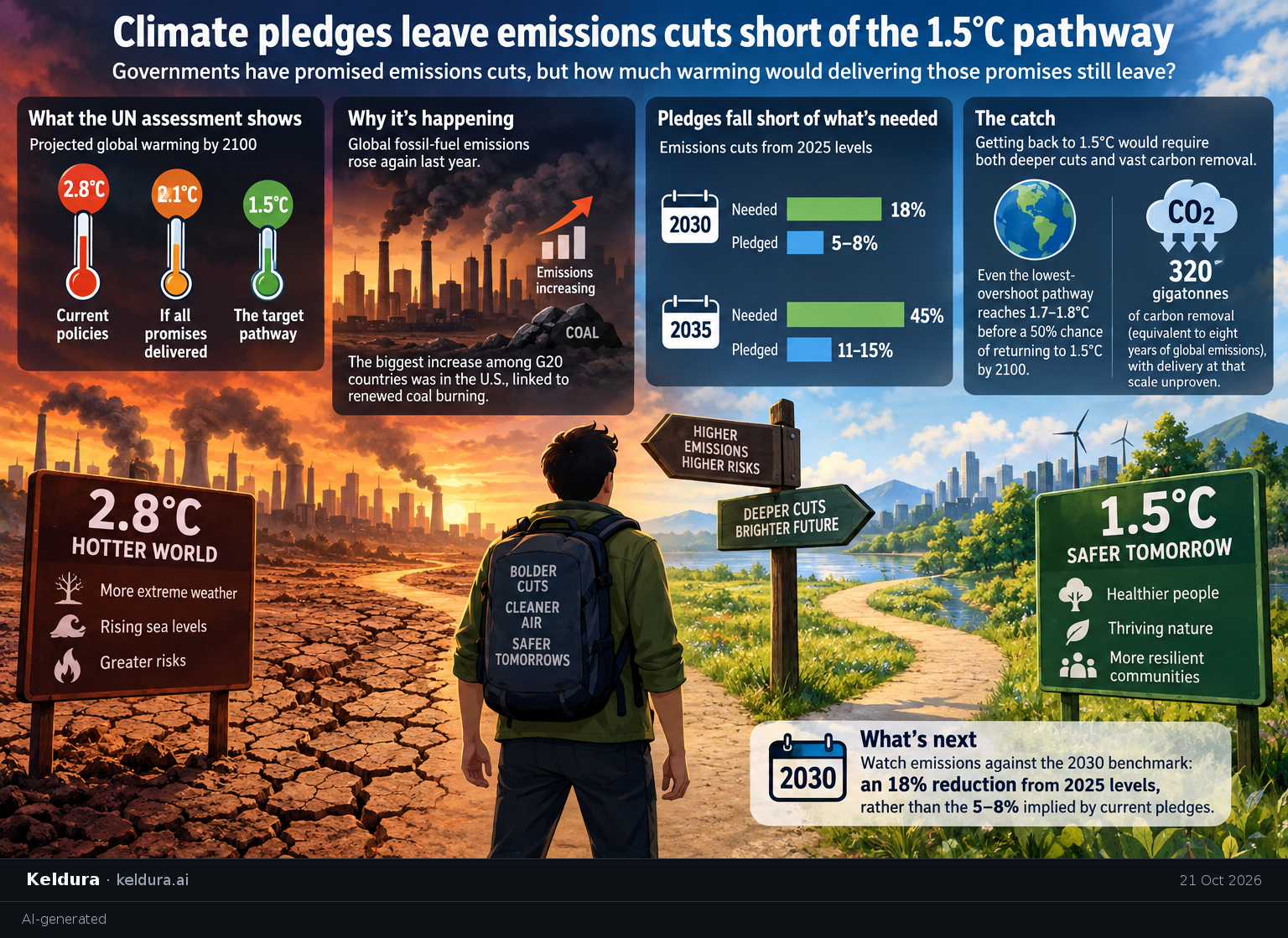
Current national policies point to 2.8°C of warming by 2100, while delivering all climate promises would lower that projection to 2.1°C, according to the UN's latest assessment. [6] Its lowest-overshoot pathway requires emissions to fall 18% by 2030 from 2025 levels, compared with the 5–8% reduction expected under countries' pledges, followed by large-scale carbon removal. [6][8]
Why it matters: The gap is between two different futures, not simply between promises and compliance: even full delivery of current pledges would leave warming above 1.5°C. Bringing temperatures back down would also depend on carbon removal at a scale whose feasibility remains unproven. [6][8]
Key insights: The near-term benchmark is an 18% emissions cut by 2030, but current pledges deliver only 5–8%; the required 2035 cut is 45%, against pledged reductions of 11–15%. [2][6][8] | Even the lowest-overshoot scenario reaches 1.7–1.8°C before offering a 50% chance of returning to 1.5°C by 2100. [6] | The US had the largest emissions increase among G20 countries last year; the report links its increase largely to renewed coal burning. [4][8] | The carbon-removal requirement cited in the assessment is 320 gigatonnes, equivalent to eight years of global carbon emissions, with delivery at that scale unproven. [8]
Cheatsheet facts: What happened: The UN assessment puts warming under current policies at 2.8°C this century, or 2.1°C if all climate promises are delivered. [6] | Why: Global fossil-fuel emissions rose again last year, and pledged reductions remain below the pace needed to limit the size and duration of a 1.5°C overshoot. [8] | The catch: Returning to 1.5°C would require both deeper emissions cuts and vast carbon removal; the assessment says socioeconomic and technological challenges make success uncertain. [6][8] | What's next: Watch emissions against the 2030 benchmark: an 18% reduction from 2025 levels, rather than the 5–8% implied by current pledges. [6][8]
X copy pack
Edition complete
You've reached the end of this edition.