Singapore buildings adopt alternatives to conventional air conditioning
Singapore is testing less energy-intensive cooling, but can alternatives reduce demand without sacrificing comfort?
On November 1, AFP reported that Singapore was expanding alternative cooling systems, with at least 47 public and private buildings using them by mid-2026.
Singapore is experimenting with technologies including chilled beams and passive displacement to reduce reliance on conventional air conditioning; authorities said at least 33 public and 14 private buildings had adopted alternative cooling technologies by mid-2026. [3] DP Architects said one buildi…
Open original · [3] 'Air-con nation' Singapore eyes alternatives to cool down | AFP.com — afp.com
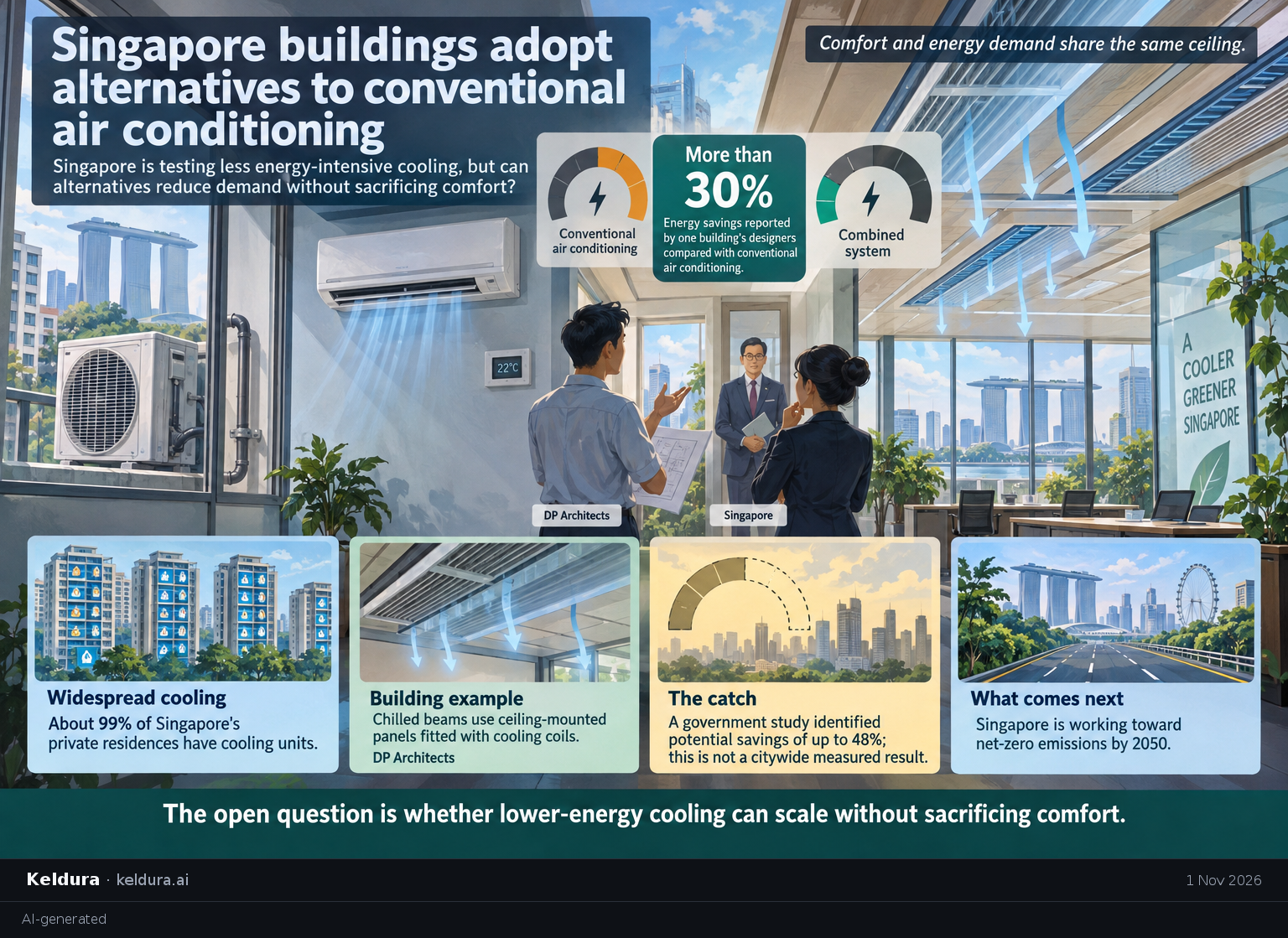
Singapore is experimenting with technologies including chilled beams and passive displacement to reduce reliance on conventional air conditioning; authorities said at least 33 public and 14 private buildings had adopted alternative cooling technologies by mid-2026. [3] DP Architects said one building's combined system reduced energy consumption by more than 30% compared with conventional air conditioning, while a government study identified potential energy savings of up to 48%. [3]
Why it matters: Cooling accounts for 40–60% of a building's energy consumption, and Singapore's building sector produces one-fifth of its emissions, making cooling equipment a substantial lever for reducing energy demand. [3]
Key insights: Conventional air conditioning creates a feedback problem: outdoor compressor units release heat, while electricity generation can add greenhouse gases when it relies on fossil fuels. [3] | Active chilled beams use ceiling-mounted panels fitted with cooling coils, providing a different delivery system from conventional air conditioning. [3] | The reported savings are not interchangeable: more than 30% comes from designers' account of one building's system, while up to 48% is a government study's estimate of potential savings. [3]
Cheatsheet facts: What happened: At least 33 public and 14 private buildings had adopted alternative cooling technologies by mid-2026. [3] | Why: Cooling consumes 40–60% of building energy, while about 99% of Singapore's private residences have cooling units. [3] | The catch: One building's designers reported savings above 30%; the larger, up-to-48% figure describes potential identified in a government study, not savings already achieved citywide. [3] | What's next: Watch whether adoption expands beyond the mid-2026 baseline of at least 47 buildings as Singapore works toward its 2050 net-zero goal. [3]
X copy pack
Edition complete
You've reached the end of this edition.