Thailand gets World Bank-backed platform for low-carbon cities and carbon markets
The World Bank Group approved a US$200 million project to help Thailand build a scalable platform that combines innovative financing with carbon-market infrastructure for public-sector energy-efficiency and renewable-energy investments.[2] The project is designed to reduce upfront costs for public…
The World Bank Group approved a US$200 million project to help Thailand build a scalable platform that combines innovative financing with carbon-market infrastructure for public-sector energy-efficiency and renewable-energy investments.[2] The project is designed to reduce upfront costs for public organizations, mobilize private investment through energy service companies and banks, and support job creation in clean energy, monitoring, and verification activities.[2]
Why it matters: This matters because it links climate policy, market infrastructure, and public finance into a replicable model for turning smaller local upgrades into bankable investment pipelines.[2] It also shows how carbon markets and public-private financing are being positioned as tools to lower costs, strengthen energy security, and support Thailand’s net-zero and carbon-neutrality ambitions.[2]
Key insights: The US$200 million Low Carbon Cities and Carbon Market Development Project will let public organizations upgrade assets without paying the full investment cost upfront.[2] | The project is expected to generate at least 1,800 job-years during implementation and additional jobs if the model is replicated nationwide.[2] | The plan includes rooftop solar and efficiency upgrades that could install up to 180 megawatts of renewable capacity and save about 448 gigawatt-hours of electricity annually.[2] | Krungthai Bank will aggregate carbon credits and connect them to carbon markets, while the Export-Import Bank of Thailand finances qualified energy service companies.[2]
Cheatsheet facts: What changed: The World Bank Group approved a new financing-and-carbon-market platform for Thailand’s public sector energy upgrades.[2] | Why now: Thailand is trying to convert climate and energy-efficiency goals into investable projects ahead of the October 2026 IMF-World Bank Group Annual Meetings in Bangkok.[2] | Watch next: The first rollout across Bangkok Metropolitan Administration and the Industrial Estate Authority of Thailand, plus signs of carbon-credit aggregation and replicated projects across other agencies.[2]
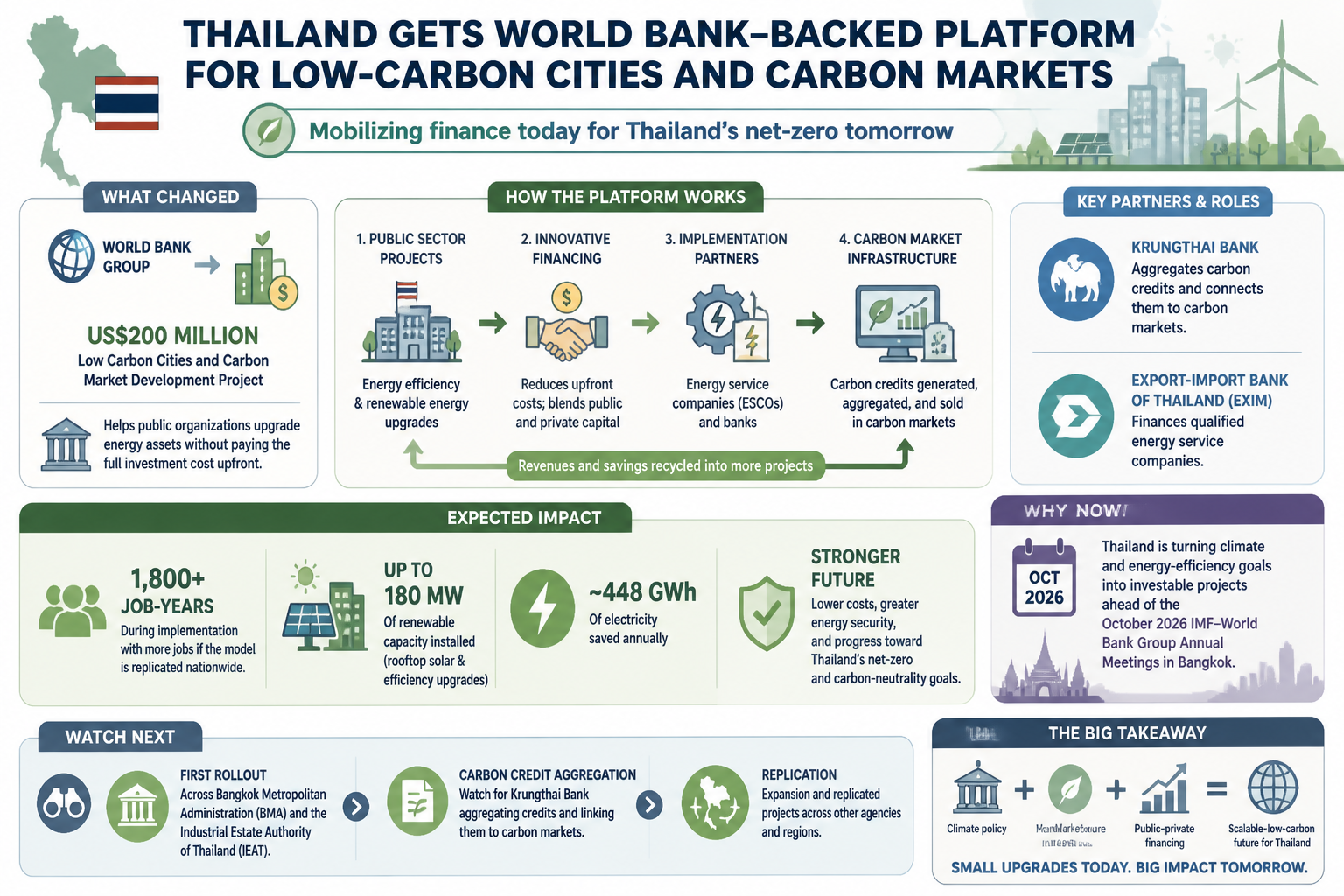
The World Bank Group approved a US$200 million project to help Thailand build a scalable platform that combines innovative financing with carbon-market infrastructure for public-sector energy-efficiency and renewable-energy investments.[2] The project is designed to reduce upfront costs for public organizations, mobilize private investment through energy service companies and banks, and support job creation in clean energy, monitoring, and verification activities.[2]
Why it matters: This matters because it links climate policy, market infrastructure, and public finance into a replicable model for turning smaller local upgrades into bankable investment pipelines.[2] It also shows how carbon markets and public-private financing are being positioned as tools to lower costs, strengthen energy security, and support Thailand’s net-zero and carbon-neutrality ambitions.[2]
Key insights: The US$200 million Low Carbon Cities and Carbon Market Development Project will let public organizations upgrade assets without paying the full investment cost upfront.[2] | The project is expected to generate at least 1,800 job-years during implementation and additional jobs if the model is replicated nationwide.[2] | The plan includes rooftop solar and efficiency upgrades that could install up to 180 megawatts of renewable capacity and save about 448 gigawatt-hours of electricity annually.[2] | Krungthai Bank will aggregate carbon credits and connect them to carbon markets, while the Export-Import Bank of Thailand finances qualified energy service companies.[2]
Cheatsheet facts: What changed: The World Bank Group approved a new financing-and-carbon-market platform for Thailand’s public sector energy upgrades.[2] | Why now: Thailand is trying to convert climate and energy-efficiency goals into investable projects ahead of the October 2026 IMF-World Bank Group Annual Meetings in Bangkok.[2] | Watch next: The first rollout across Bangkok Metropolitan Administration and the Industrial Estate Authority of Thailand, plus signs of carbon-credit aggregation and replicated projects across other agencies.[2]