BepiColombo Begins Its Final Approach to Mercury
BepiColombo’s Mercury Transfer Module successfully separated from the spacecraft stack on 3 September after nearly eight years, 9.9 billion kilometres and nine planetary flybys.[2][3] The milestone begins a six-month arrival sequence intended to place ESA’s Mercury Planetary Orbiter and JAXA’s Mio…
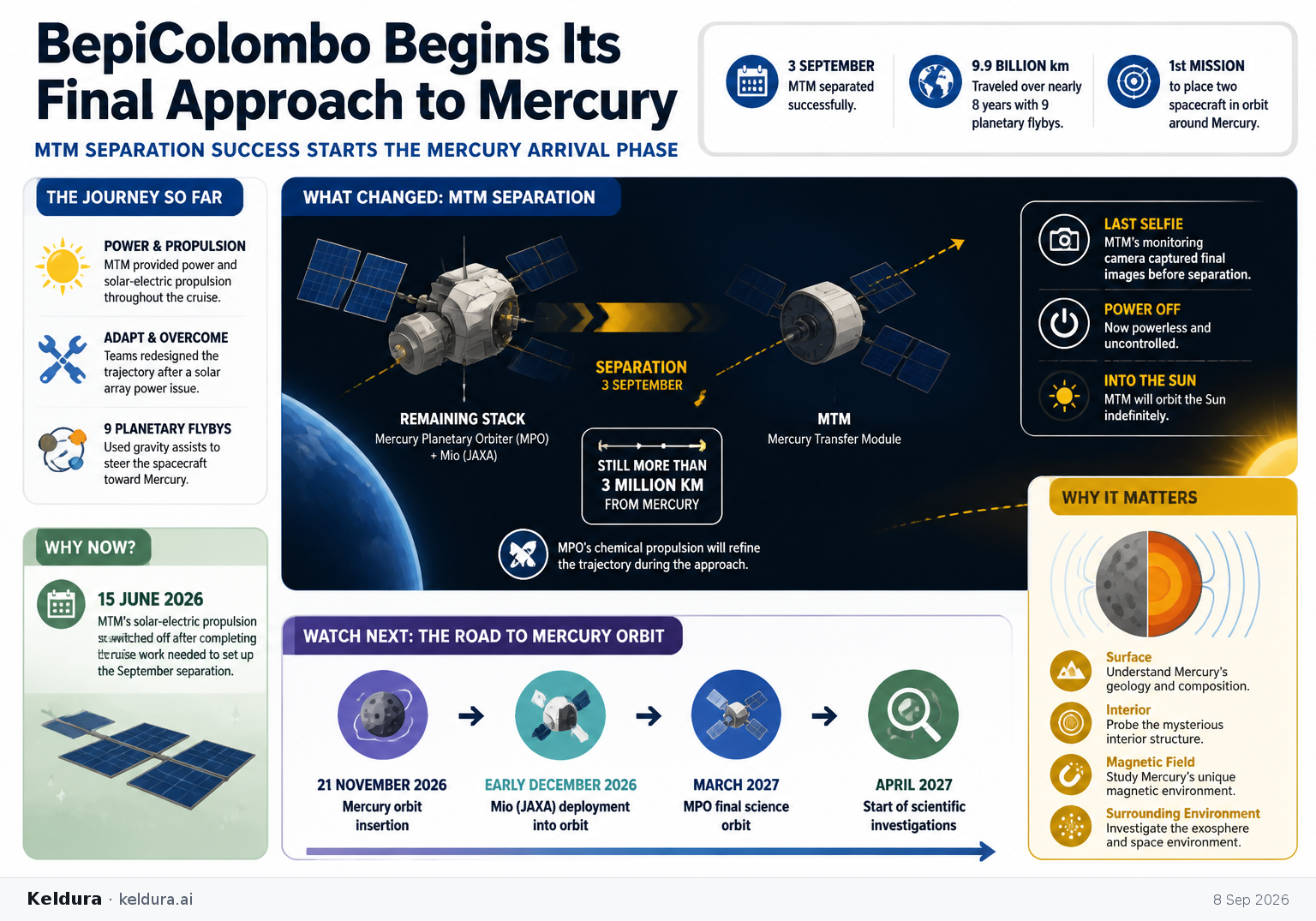
BepiColombo’s Mercury Transfer Module successfully separated from the spacecraft stack on 3 September after nearly eight years, 9.9 billion kilometres and nine planetary flybys.[2][3] The milestone begins a six-month arrival sequence intended to place ESA’s Mercury Planetary Orbiter and JAXA’s Mio in orbit around Mercury.[3]
Why it matters: BepiColombo is designed to become the first mission to place two spacecraft in orbit around Mercury, enabling complementary investigations of the planet’s surface, interior, magnetic field and surrounding environment.[3]
Key insights: MTM supplied power and solar-electric propulsion during the journey, including after teams redesigned the trajectory because an issue reduced the power available from its solar arrays.[3] | The remaining stack was still more than three million kilometres from Mercury after separation and will use MPO’s chemical propulsion system to refine its trajectory.[3] | MTM took final monitoring-camera images before separation; now powerless and uncontrolled, it will orbit the Sun indefinitely.[2]
Cheatsheet facts: What changed: MTM separated successfully, ending its transport role and starting BepiColombo’s Mercury arrival phase.[2][3] | Why now: MTM’s solar-electric propulsion was switched off on 15 June 2026 after completing the cruise work needed to set up the September separation.[3] | Watch next: Mercury orbit insertion is scheduled for 21 November, followed by Mio’s deployment in early December, MPO’s final science orbit in March 2027 and scientific investigations from April 2027.[3]
BepiColombo’s Mercury Transfer Module successfully separated from the spacecraft stack on 3 September after nearly eight years, 9.9 billion kilometres and nine planetary flybys.[2][3] The milestone begins a six-month arrival sequence intended to place ESA’s Mercury Planetary Orbiter and JAXA’s Mio in orbit around Mercury.[3]
Why it matters: BepiColombo is designed to become the first mission to place two spacecraft in orbit around Mercury, enabling complementary investigations of the planet’s surface, interior, magnetic field and surrounding environment.[3]
Key insights: MTM supplied power and solar-electric propulsion during the journey, including after teams redesigned the trajectory because an issue reduced the power available from its solar arrays.[3] | The remaining stack was still more than three million kilometres from Mercury after separation and will use MPO’s chemical propulsion system to refine its trajectory.[3] | MTM took final monitoring-camera images before separation; now powerless and uncontrolled, it will orbit the Sun indefinitely.[2]
Cheatsheet facts: What changed: MTM separated successfully, ending its transport role and starting BepiColombo’s Mercury arrival phase.[2][3] | Why now: MTM’s solar-electric propulsion was switched off on 15 June 2026 after completing the cruise work needed to set up the September separation.[3] | Watch next: Mercury orbit insertion is scheduled for 21 November, followed by Mio’s deployment in early December, MPO’s final science orbit in March 2027 and scientific investigations from April 2027.[3]