Swift reenters Earth’s atmosphere after an unsuccessful rescue
A robot was sent to extend Swift’s life, but why did the rescuer return to Earth before the telescope?
On November 4, NASA’s 1,450-kilogram Swift observatory reentered Earth’s atmosphere over northern Sumatra, ending a 22-year mission after an unsuccessful orbital rescue.
NASA’s Swift observatory reentered the atmosphere on November 4 after 22 years observing cosmic explosions. A commercial spacecraft, LINK, had been sent to raise its orbit, but the capture was called off in August and LINK itself reentered in September. [4][6][9]
Open original (3 sources):
- [4] NASA’s Swift telescope has burned up, months after a robot sent to save it failed – here’s why it’s so hard to boost a satellite — theconversation.com
- [6] NASA's Swift space telescope crashes back to Earth after failed rescue attempt | Space — Space.com
- [9] NASA space telescope plunges to Earth after failed rescue mission | AP News — apnews.com
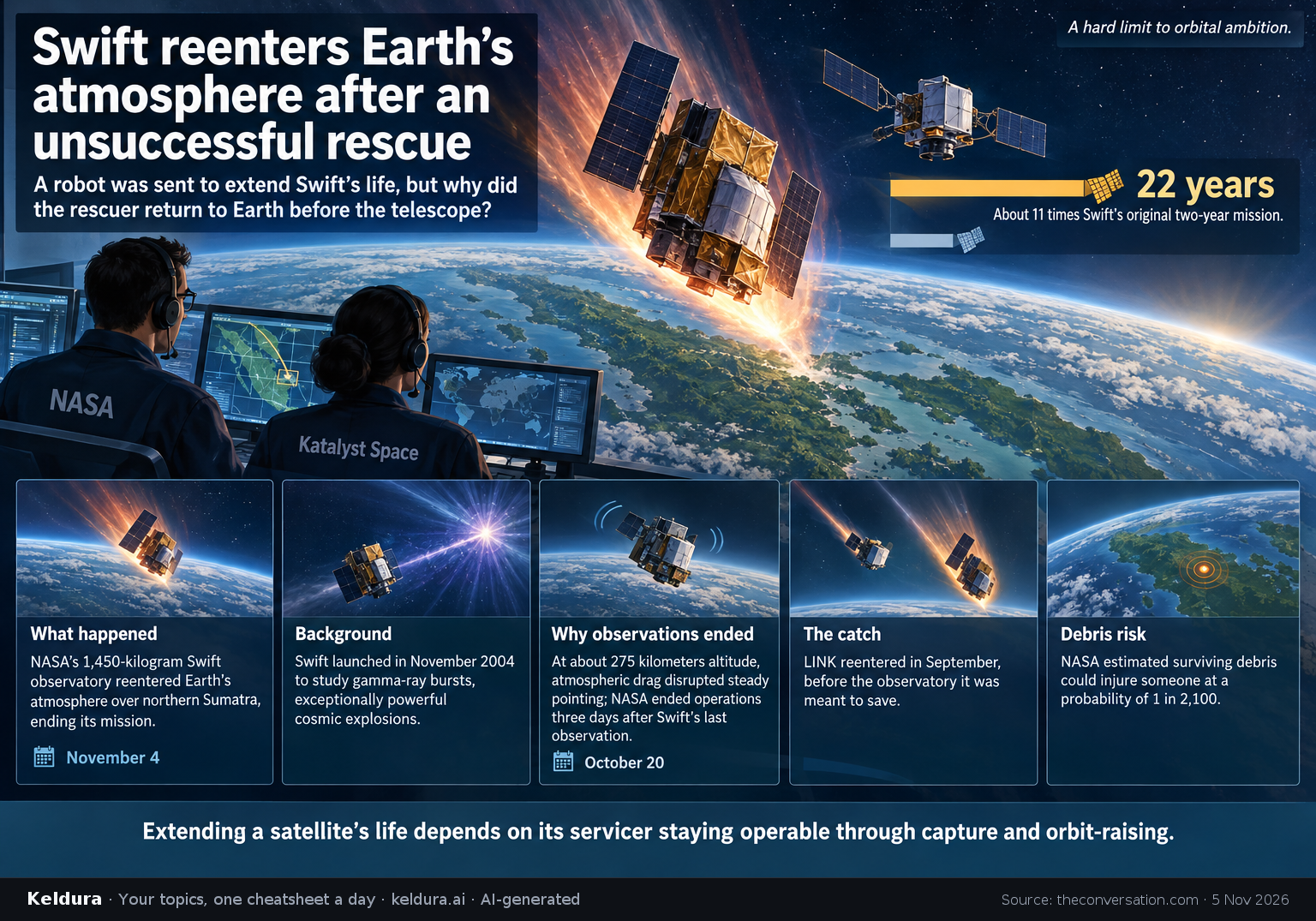
NASA’s Swift observatory reentered the atmosphere on November 4 after 22 years observing cosmic explosions. A commercial spacecraft, LINK, had been sent to raise its orbit, but the capture was called off in August and LINK itself reentered in September. [4][6][9]
Why it matters: Astronomers have lost an observatory that studied gamma-ray bursts for roughly 11 times its original two-year mission. Its attempted rescue also illustrates a practical constraint on extending satellite lifetimes: the servicing spacecraft must remain operable long enough to reach, capture and move its target. [4][6]
Key insights: Swift last observed the sky on October 20 at about 275 kilometers altitude; NASA ended operations three days later because atmospheric drag prevented steady pointing. [4] | LINK approached within 12–15 kilometers and tested its three robotic arms and electric thrusters, but never reached Swift to capture it. [4] | Before reentry, NASA expected most of the 1,450-kilogram observatory to burn up and estimated the chance of surviving debris injuring anyone at 1 in 2,100. [6]
Cheatsheet facts: What happened: Swift reentered over northern Sumatra on November 4 after 22 years in orbit. [6][9] | Background: Launched in November 2004 for a two-year mission, Swift studied gamma-ray bursts, exceptionally powerful cosmic explosions. [6] | Why: Its orbit became low enough that atmospheric drag disrupted the steady pointing its telescopes required. [4] | The catch: The rescue spacecraft LINK never captured Swift and reentered in September, before the observatory it was meant to save. [4]