Unep reframes the 1.5°C challenge around limiting overshoot
Unep says the world is likely to cross the 1.5°C long-term warming threshold within the next few years, with warming expected to peak near 1.8°C even if governments fully implement climate plans and additional net-zero commitments.[3] Its proposed “overshoot, peak and decline” pathway calls for lim…
Unep says the world is likely to cross the 1.5°C long-term warming threshold within the next few years, with warming expected to peak near 1.8°C even if governments fully implement climate plans and additional net-zero commitments.[3] Its proposed “overshoot, peak and decline” pathway calls for limiting the height and duration of the breach before bringing warming back toward 1.5°C by the end of the century.[3]
Why it matters: A return below 1.5°C would not reverse all damage incurred during an overshoot, so every fraction of a degree avoided and every year removed from the breach would reduce exposure to long-lasting or irreversible harm.[3]
Key insights: Unep says policy must now combine faster emissions cuts with preparation and adaptation for temperatures above 1.5°C.[3] | The agency describes overshoot and decline as the least damaging remaining pathway if the threshold is breached, not an acceptable substitute for avoiding the breach.[3] | The severity and duration of overshoot will depend largely on the speed of emissions reductions and improvements in countries’ adaptive capacity.[3] | Unep calls for stronger political will, international cooperation, finance, technology transfer and capacity-building.[3]
Cheatsheet facts: What changed: Unep says climate strategy must address a probable temporary breach of 1.5°C while preserving the goal of returning below it.[3] | Why now: Even an optimistic implementation of existing climate plans and added net-zero commitments points to a peak of about 1.8°C.[3] | Watch next: Track whether governments strengthen emissions cuts, adaptation, climate finance and technology transfer in response to the report.[3]
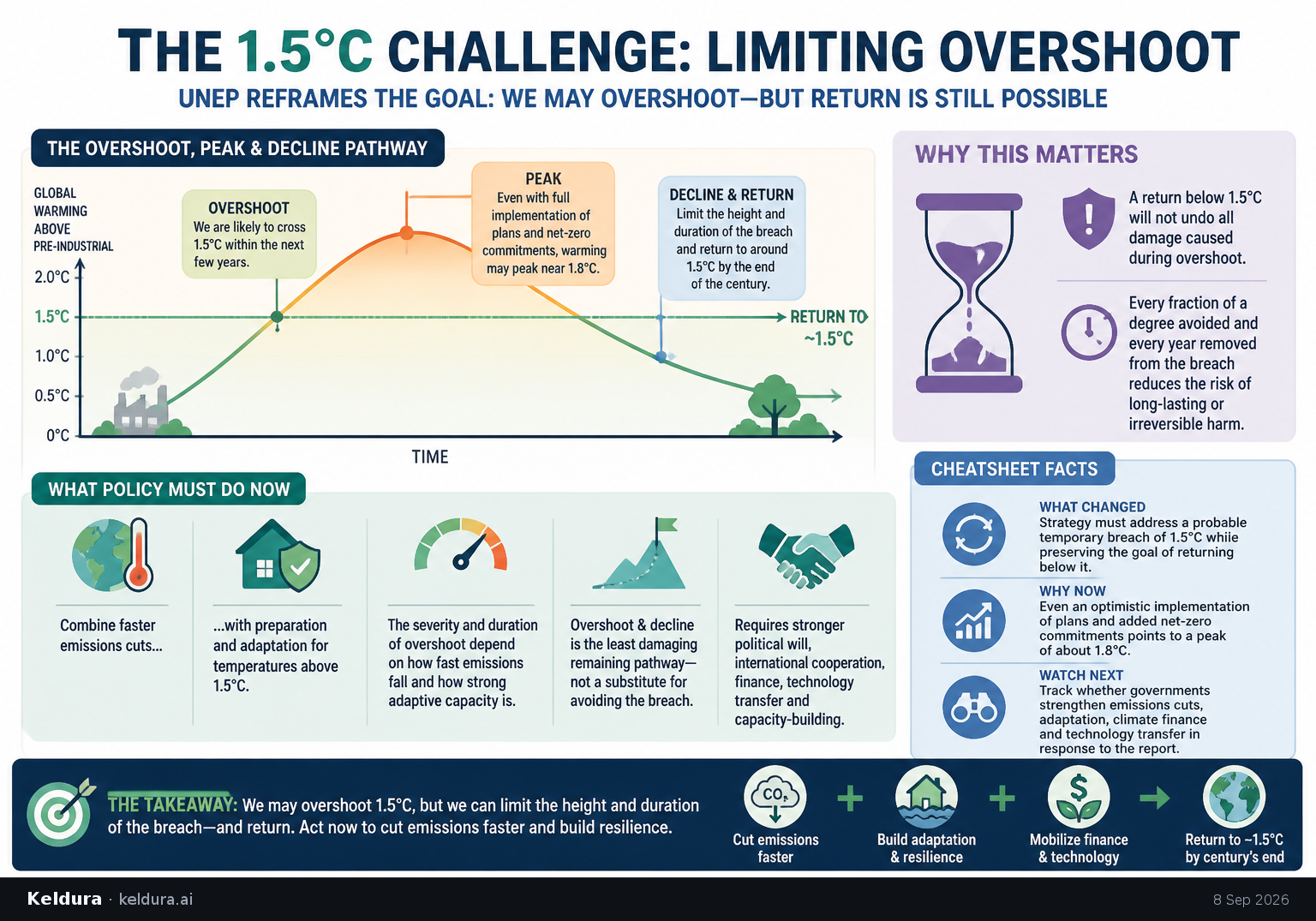
Unep says the world is likely to cross the 1.5°C long-term warming threshold within the next few years, with warming expected to peak near 1.8°C even if governments fully implement climate plans and additional net-zero commitments.[3] Its proposed “overshoot, peak and decline” pathway calls for limiting the height and duration of the breach before bringing warming back toward 1.5°C by the end of the century.[3]
Why it matters: A return below 1.5°C would not reverse all damage incurred during an overshoot, so every fraction of a degree avoided and every year removed from the breach would reduce exposure to long-lasting or irreversible harm.[3]
Key insights: Unep says policy must now combine faster emissions cuts with preparation and adaptation for temperatures above 1.5°C.[3] | The agency describes overshoot and decline as the least damaging remaining pathway if the threshold is breached, not an acceptable substitute for avoiding the breach.[3] | The severity and duration of overshoot will depend largely on the speed of emissions reductions and improvements in countries’ adaptive capacity.[3] | Unep calls for stronger political will, international cooperation, finance, technology transfer and capacity-building.[3]
Cheatsheet facts: What changed: Unep says climate strategy must address a probable temporary breach of 1.5°C while preserving the goal of returning below it.[3] | Why now: Even an optimistic implementation of existing climate plans and added net-zero commitments points to a peak of about 1.8°C.[3] | Watch next: Track whether governments strengthen emissions cuts, adaptation, climate finance and technology transfer in response to the report.[3]