How a personalized mRNA vaccine trains immunity against melanoma
Merck and Moderna announced on August 19 that their personalized melanoma therapy had met the primary goal of a phase 3 trial.
The experimental regimen combines intismeran autogene, an individualized mRNA neoantigen therapy, with the immunotherapy pembrolizumab for patients whose stage IIB–IV melanoma has been completely removed [3]. The phase 3 trial enrolled more than 1,000 patients at risk of recurrence and compared the…
Open original (2 sources):
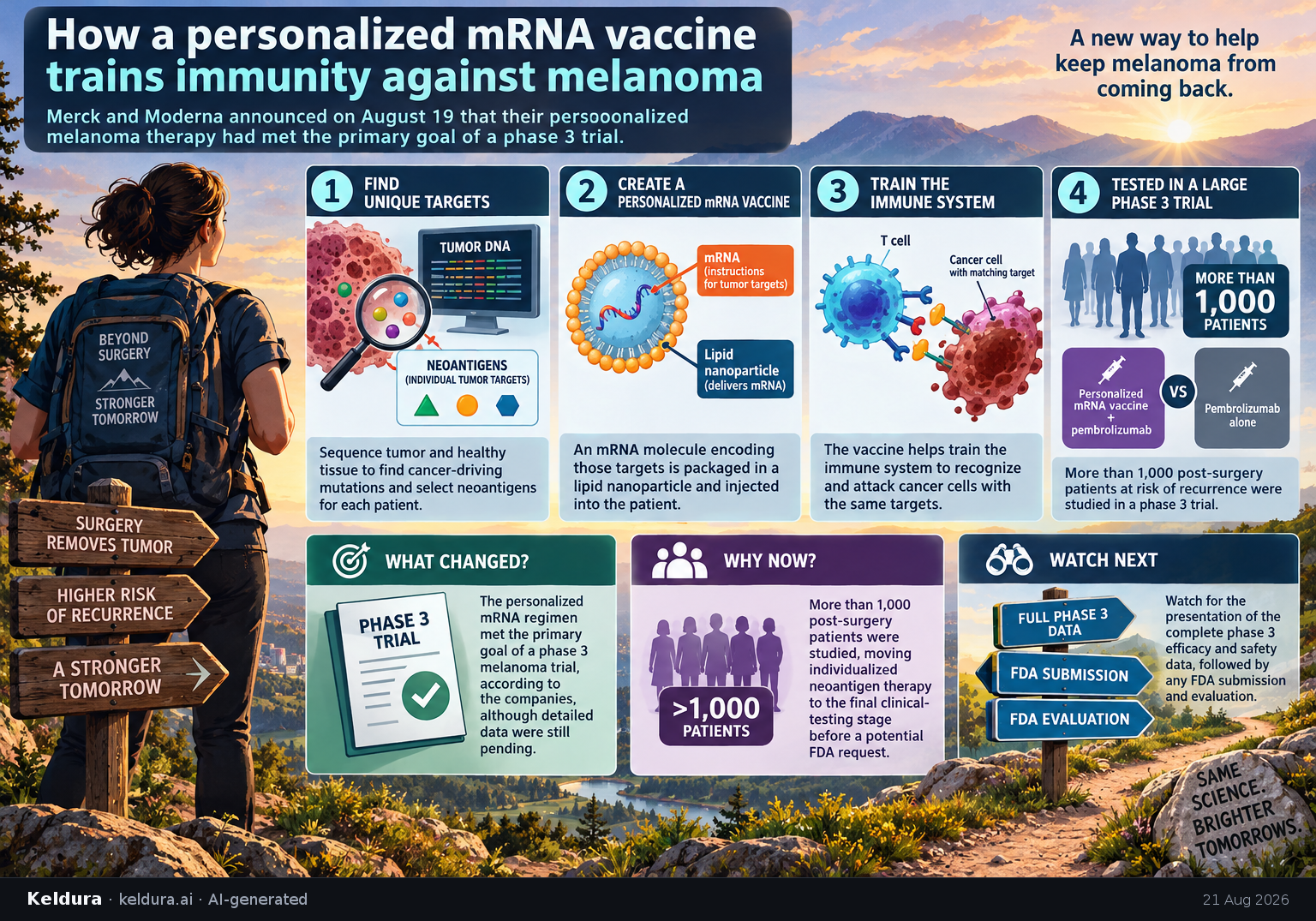
The experimental regimen combines intismeran autogene, an individualized mRNA neoantigen therapy, with the immunotherapy pembrolizumab for patients whose stage IIB–IV melanoma has been completely removed [3]. The phase 3 trial enrolled more than 1,000 patients at risk of recurrence and compared the combination with pembrolizumab alone, but detailed phase 3 data had not yet been released at the time of reporting [4].
Why it matters: This is the first mRNA cancer vaccine reported to have reached this stage of development, potentially extending mRNA technology from infectious-disease prevention to individualized cancer treatment [4]. Because surgery may leave patients at risk of recurrence, the approach is designed to help the immune system recognize tumor-specific targets after removal [3][4].
Key insights: Researchers sequence tumor and healthy tissue to identify cancer-driving mutations, then use algorithms to select neoantigens associated with the individual tumor [4]. | An mRNA molecule encodes instructions for those targets, is packaged in a lipid nanoparticle and is injected to train the immune system to attack matching cancer cells [4]. | The phase 3 comparison tested the personalized vaccine plus pembrolizumab against pembrolizumab alone in more than 1,000 patients [4]. | The reported 49% reduction in recurrence or death should not be treated as a fully disclosed phase 3 estimate: one account associated it with five-year follow-up [3], while another said phase 3 details remained unreleased and linked 49% to the earlier phase 2 trial [4].
Cheatsheet facts: What changed: The personalized mRNA regimen met the primary goal of a phase 3 melanoma trial, according to the companies, although detailed data were still pending [4]. | Why now: More than 1,000 post-surgery patients were studied, moving individualized neoantigen therapy to the final clinical-testing stage before a potential FDA request [4]. | Watch next: Watch for presentation of the complete phase 3 efficacy and safety data, followed by any FDA submission and evaluation [4].
X copy pack
Edition complete
You've reached the end of this edition.