Can Africa turn trained health professionals into a functioning workforce?
African health ministers endorsed a 10-year agenda on August 26 to train, employ and retain 3 million additional health workers by 2035.
The Africa Health Workforce Agenda 2026–2035 shifts the emphasis from education alone to coordinated planning, job creation, financing and retention.[1] A complementary financing strategy seeks to mobilize more domestic funding, pool resources and improve how health services are purchased as govern…
Open original (2 sources):
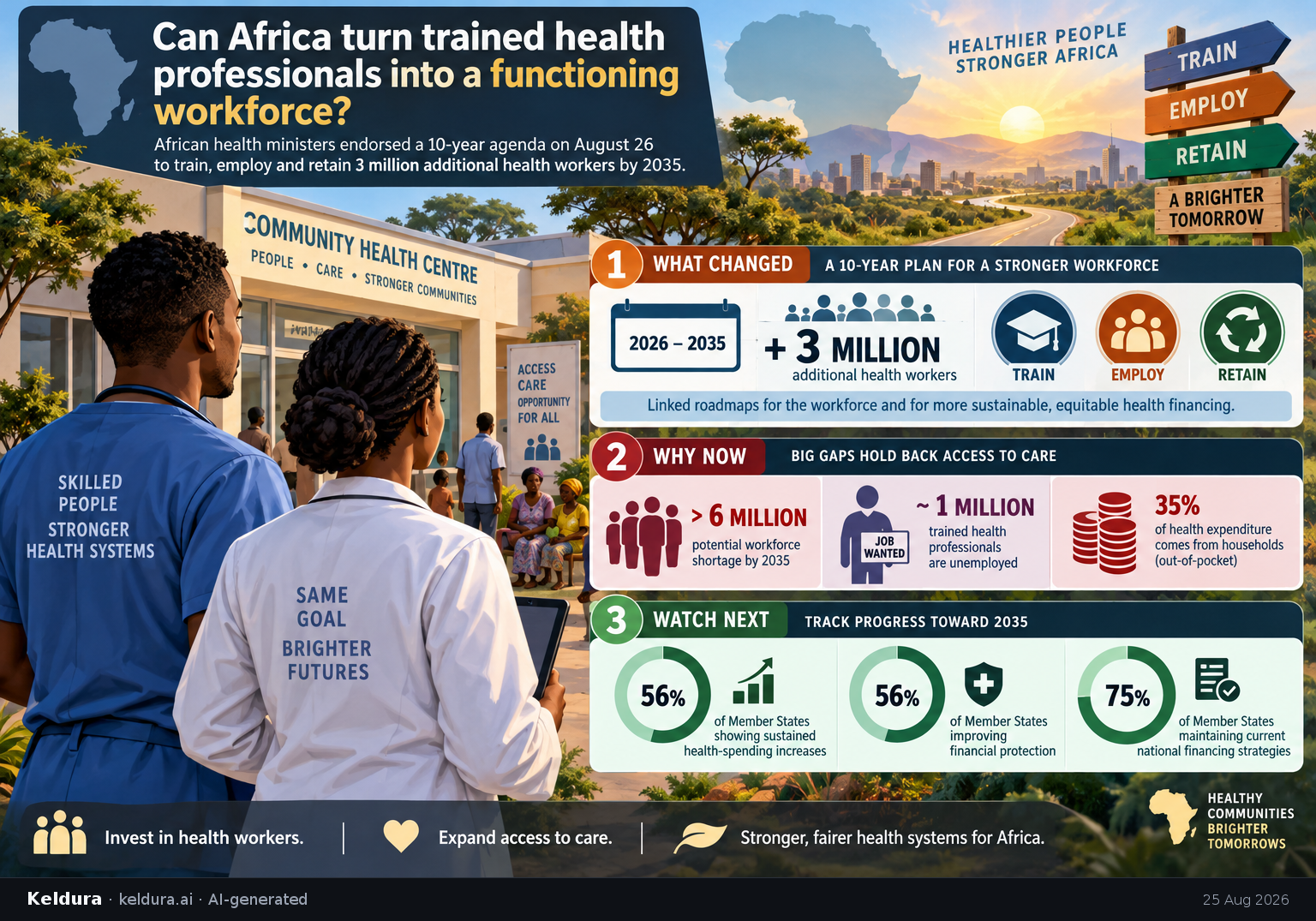
The Africa Health Workforce Agenda 2026–2035 shifts the emphasis from education alone to coordinated planning, job creation, financing and retention.[1] A complementary financing strategy seeks to mobilize more domestic funding, pool resources and improve how health services are purchased as government budgets face debt pressure and declining external assistance.[2]
Why it matters: Africa had an estimated 5.72 million health workers in 2024 but only about 46% of the workforce it needs, even as roughly one million trained health professionals remained unemployed.[1] Meanwhile, out-of-pocket health costs push around 385 million people into or deeper into poverty each year, showing that staffing and financing failures directly constrain access to care.[2]
Key insights: Without decisive action, Africa could face a shortage of more than 6 million health workers by 2035.[1] | In several countries, more than half of newly qualified nurses, doctors and midwives cannot find employment soon after graduation, exposing a mismatch between training and funded positions.[1] | Households directly fund an average of 35% of current health expenditure in the region, compared with the WHO benchmark of 20%.[2] | Closing the workforce gap is estimated to require another US$ 4 to US$ 6 per person annually.[1]
Cheatsheet facts: What changed: Ministers adopted linked 2026–2035 roadmaps for adding 3 million workers and building more sustainable, equitable health-financing systems.[1][2] | Why now: The region faces a potential workforce shortage above 6 million, about one million unemployed trained professionals and household payments averaging 35% of health expenditure.[1][2] | Watch next: Track funded health-sector jobs and whether Member States move toward the strategy targets: 56% showing sustained health-spending increases, 56% improving financial protection and 75% maintaining current national financing strategies by 2035.[1][2]
X copy pack
Edition complete
You've reached the end of this edition.