Private Earth Observation and AI Raise New Trust and Security Risks
An OECD report says improvements in optics, photonics, cloud computing and artificial intelligence have expanded the quality and accessibility of satellite Earth-observation data.[6] It also identifies risks involving privacy, national security, ethical use and the manipulation or misinterpretation…
An OECD report says improvements in optics, photonics, cloud computing and artificial intelligence have expanded the quality and accessibility of satellite Earth-observation data.[6] It also identifies risks involving privacy, national security, ethical use and the manipulation or misinterpretation of satellite imagery.[6]
Why it matters: Earth observation is inherently dual-use: systems that identify illegal fishing can also reveal military troop movements, widening access to strategically sensitive information.[6]
Key insights: The report describes Earth observation as an increasingly private activity and examines the consequences of broader access to advanced satellite data.[6] | Combining Earth-observation data with AI creates additional concerns about privacy, security and ethical use.[6] | Fake, misinterpreted or intentionally misrepresented imagery can erode public trust in satellite evidence.[6]
Cheatsheet facts: What changed: The OECD has formally highlighted the governance risks accompanying wider commercial access to high-quality, AI-enabled satellite observations.[6] | Why now: Converging advances in sensing, cloud infrastructure and AI have democratized satellite-data quality and accessibility.[6] | Watch next: A key observable indicator is the incidence and handling of fake, misinterpreted or intentionally misrepresented satellite imagery.[6]
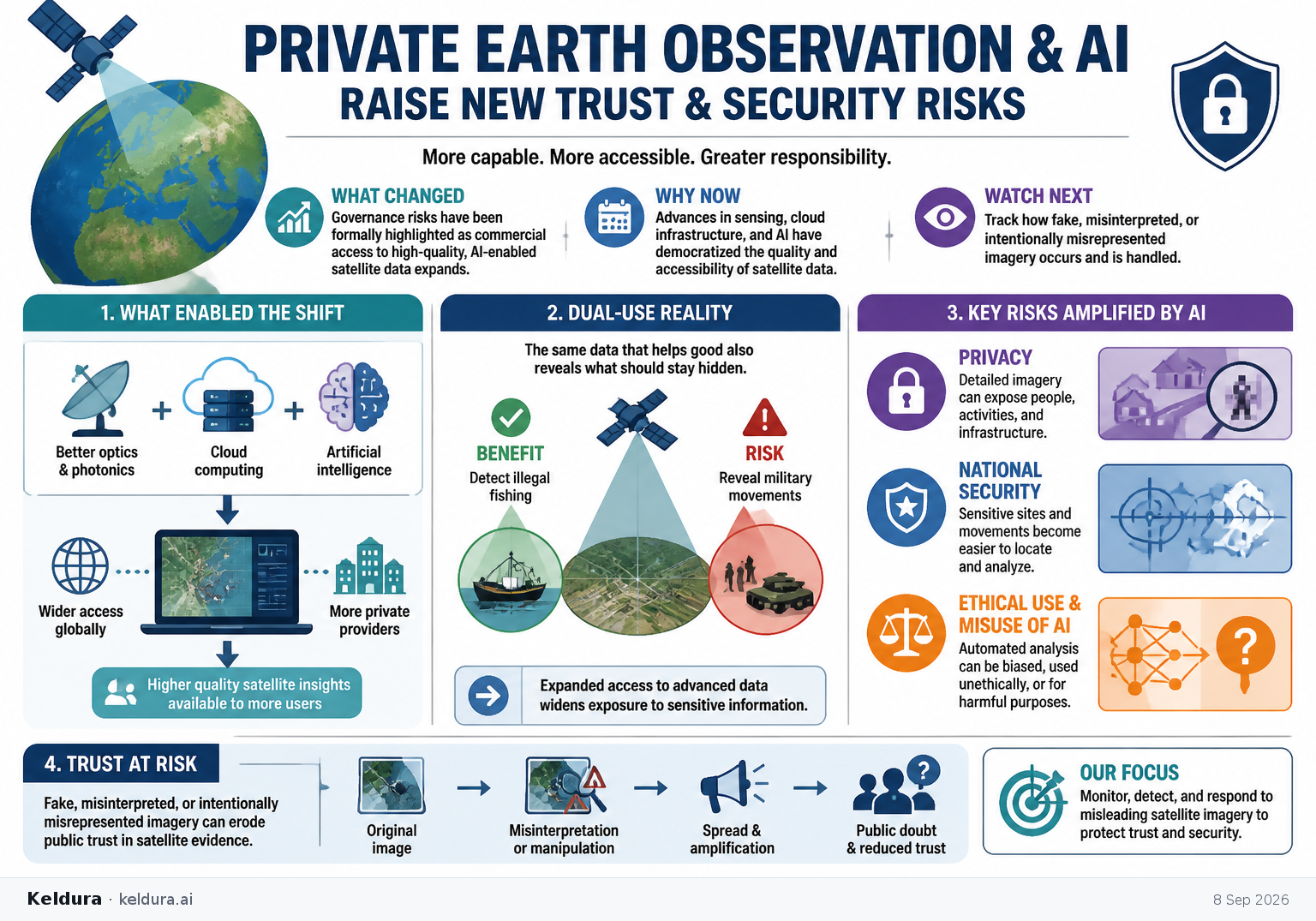
An OECD report says improvements in optics, photonics, cloud computing and artificial intelligence have expanded the quality and accessibility of satellite Earth-observation data.[6] It also identifies risks involving privacy, national security, ethical use and the manipulation or misinterpretation of satellite imagery.[6]
Why it matters: Earth observation is inherently dual-use: systems that identify illegal fishing can also reveal military troop movements, widening access to strategically sensitive information.[6]
Key insights: The report describes Earth observation as an increasingly private activity and examines the consequences of broader access to advanced satellite data.[6] | Combining Earth-observation data with AI creates additional concerns about privacy, security and ethical use.[6] | Fake, misinterpreted or intentionally misrepresented imagery can erode public trust in satellite evidence.[6]
Cheatsheet facts: What changed: The OECD has formally highlighted the governance risks accompanying wider commercial access to high-quality, AI-enabled satellite observations.[6] | Why now: Converging advances in sensing, cloud infrastructure and AI have democratized satellite-data quality and accessibility.[6] | Watch next: A key observable indicator is the incidence and handling of fake, misinterpreted or intentionally misrepresented satellite imagery.[6]