Samba’s Targeted Reentry Delivers Rare Breakup Data
ESA’s Samba satellite reentered over the South Pacific at 21:39:38 UTC on 31 August 2026 after controllers adjusted its trajectory to support a safe, closely observed descent.[5] Scientists aboard an aircraft from Tonga recorded the breakup, and the final reentry prediction proved accurate to the s…
ESA’s Samba satellite reentered over the South Pacific at 21:39:38 UTC on 31 August 2026 after controllers adjusted its trajectory to support a safe, closely observed descent.[5] Scientists aboard an aircraft from Tonga recorded the breakup, and the final reentry prediction proved accurate to the second.[5]
Why it matters: Measurements of how satellites heat, fragment and shed surviving materials can help engineers create spacecraft that burn up more completely while reducing atmospheric pollution.[5]
Key insights: Samba was the third of four Cluster satellites and followed targeted reentries by Salsa and Rumba.[5] | Its trajectory was changed in November 2024 and refined in January 2026 so the observation aircraft could reach the predicted location.[5] | Twenty-nine of the aircraft’s 30 instruments captured data, including tracking imagery used to assess fragmentation and the relative positions of debris.[5]
Cheatsheet facts: What changed: ESA captured Samba’s complete targeted demise using an aircraft-based suite of cameras and material-sensitive instruments.[5] | Why now: Lessons from the 2024 Salsa campaign and later trajectory refinements enabled a reentry prediction accurate to the second.[5] | Watch next: The observable follow-up is the release of processed imagery, video and instrument results showing Samba’s fragmentation and surviving materials.[5]
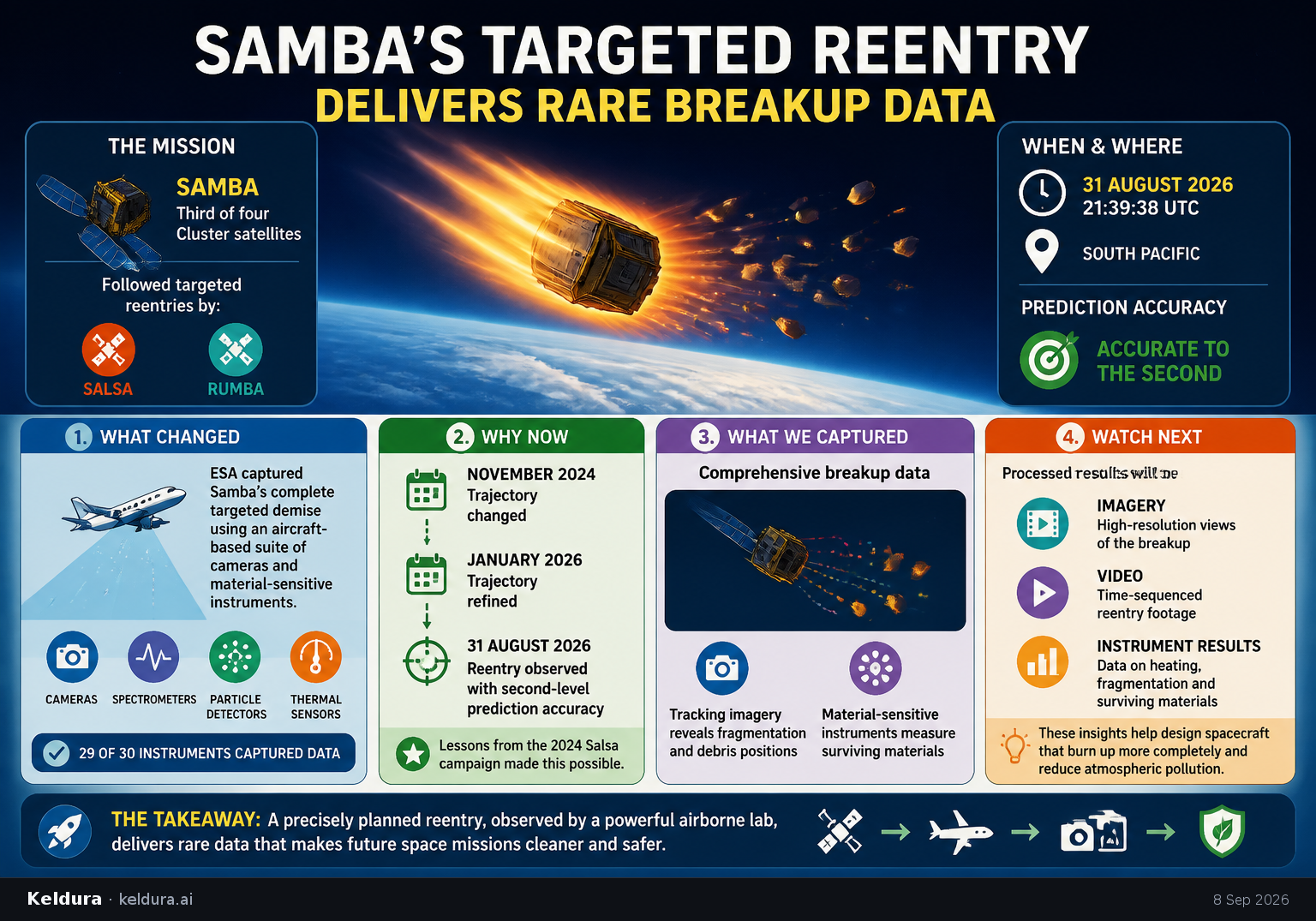
ESA’s Samba satellite reentered over the South Pacific at 21:39:38 UTC on 31 August 2026 after controllers adjusted its trajectory to support a safe, closely observed descent.[5] Scientists aboard an aircraft from Tonga recorded the breakup, and the final reentry prediction proved accurate to the second.[5]
Why it matters: Measurements of how satellites heat, fragment and shed surviving materials can help engineers create spacecraft that burn up more completely while reducing atmospheric pollution.[5]
Key insights: Samba was the third of four Cluster satellites and followed targeted reentries by Salsa and Rumba.[5] | Its trajectory was changed in November 2024 and refined in January 2026 so the observation aircraft could reach the predicted location.[5] | Twenty-nine of the aircraft’s 30 instruments captured data, including tracking imagery used to assess fragmentation and the relative positions of debris.[5]
Cheatsheet facts: What changed: ESA captured Samba’s complete targeted demise using an aircraft-based suite of cameras and material-sensitive instruments.[5] | Why now: Lessons from the 2024 Salsa campaign and later trajectory refinements enabled a reentry prediction accurate to the second.[5] | Watch next: The observable follow-up is the release of processed imagery, video and instrument results showing Samba’s fragmentation and surviving materials.[5]