Astronauts complete the space station’s eight-array power upgrade
The space station has finished adding new solar arrays, but how long must the extra electricity keep its aging systems running?
On November 5, 2026, Anil Menon and Joshua Kutryk installed the International Space Station’s eighth and final roll-out solar array during a six-hour, 59-minute spacewalk.
NASA astronaut Anil Menon and Canadian Space Agency astronaut Joshua Kutryk completed the International Space Station’s solar-power upgrade by installing and deploying its final roll-out array. The campaign began in February 2021 and required 18 spacewalks; NASA says the eight arrays raise generati…
Open original (3 sources):
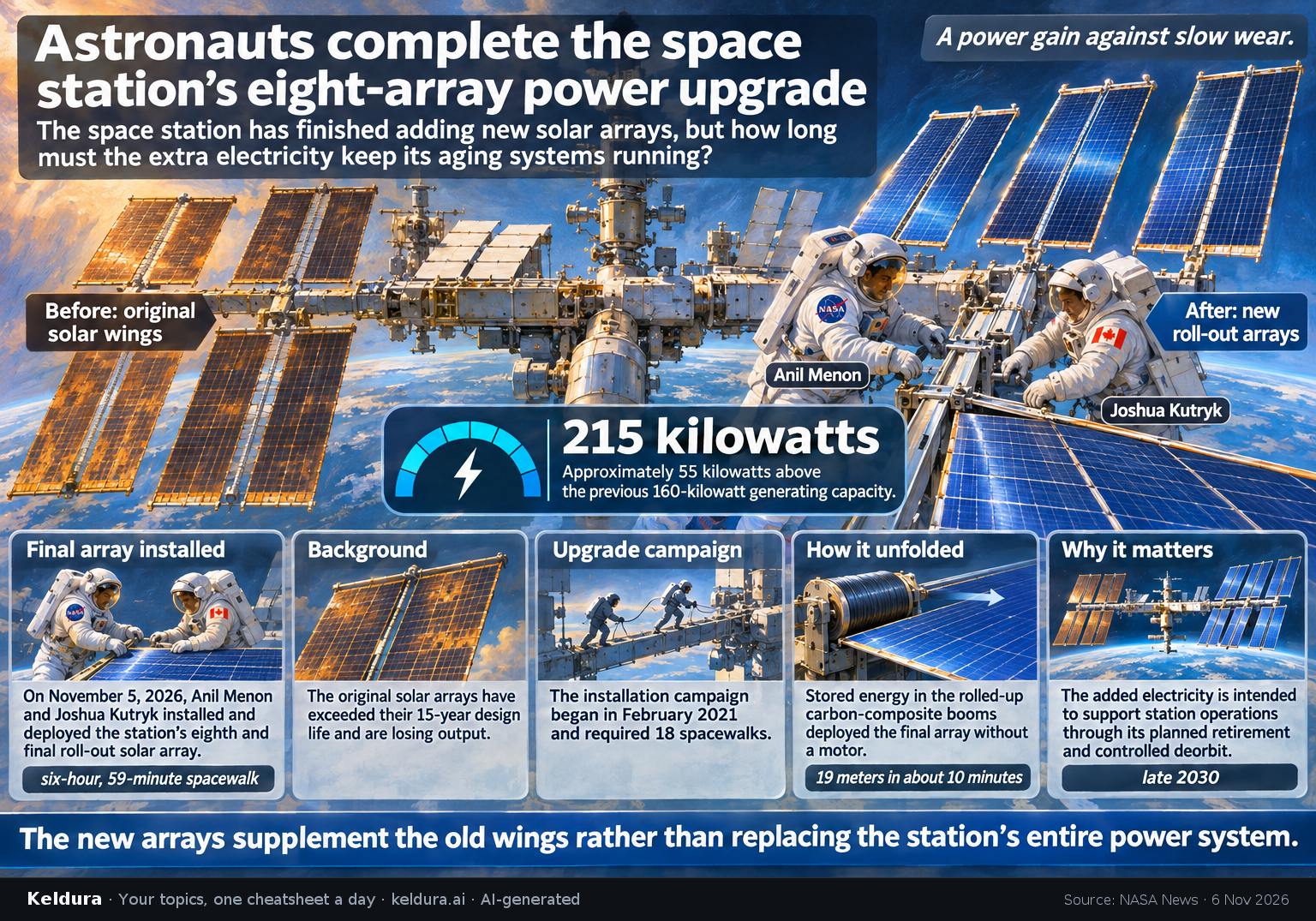
NASA astronaut Anil Menon and Canadian Space Agency astronaut Joshua Kutryk completed the International Space Station’s solar-power upgrade by installing and deploying its final roll-out array. The campaign began in February 2021 and required 18 spacewalks; NASA says the eight arrays raise generating capacity from 160 to approximately 215 kilowatts. [3][4][6]
Why it matters: The additional electricity supports station operations as the original solar arrays lose output after exceeding their 15-year design life. The new arrays are intended to help keep the station operating through retirement and controlled deorbit, currently scheduled for late 2030. [4]
Key insights: NASA’s capacity figures imply approximately 55 additional kilowatts, or about 34% more than the previous 160-kilowatt capacity. [3] | The final array extended to 19 meters in about 10 minutes without a motor: stored energy in its rolled-up carbon-composite booms drove deployment. [4] | The upgrade required 18 spacewalks over more than five years, including preparation of the station’s power-channel equipment. [3]
Cheatsheet facts: What happened: Menon and Kutryk installed and deployed the eighth and final roll-out array during a six-hour, 59-minute spacewalk on November 5. [3][6] | Why: The original solar arrays began losing output after exceeding their 15-year design life. [4] | The catch: This is an extension of an aging station’s capabilities, with retirement and controlled deorbit currently scheduled for late 2030. [4] | What's next: The new arrays are intended to support station operations through the planned late-2030 retirement and deorbit. [4]