Central Asia Tests Cross-Border Readiness for Zoonotic Threats
Exercise CARAVAN 2026 will test how Central Asian countries coordinate, communicate and share information during an evolving simulated zoonotic emergency.[1] National International Health Regulations Focal Points will work remotely with animal-health, environmental and emergency-management sectors…
Exercise CARAVAN 2026 will test how Central Asian countries coordinate, communicate and share information during an evolving simulated zoonotic emergency.[1] National International Health Regulations Focal Points will work remotely with animal-health, environmental and emergency-management sectors under conditions designed to resemble their normal operating environments.[1]
Why it matters: More than 60% of reported emerging infectious diseases originate in wild or domestic animals, while Central Asia’s cross-border movement of people, animals and goods can allow health threats to affect several countries simultaneously.[1]
Key insights: The exercise is part of a Pandemic Fund-supported multicountry project advancing the One Health approach.[1] | Participants will simulate real-time communication, event assessment and coordination with national stakeholders, neighbouring countries, WHO and other partners.[1] | The functional exercise will last approximately four hours and be followed by a 45-minute debriefing.[1]
Cheatsheet facts: What changed: Central Asian countries are conducting a regional functional simulation focused on emerging zoonotic threats.[1] | Why now: Shared ecosystems and extensive cross-border movement create opportunities for zoonotic diseases to spread among multiple countries.[1] | Watch next: Watch the exercise debrief for identified gaps in cross-border communication, joint assessment and multisectoral coordination.[1]
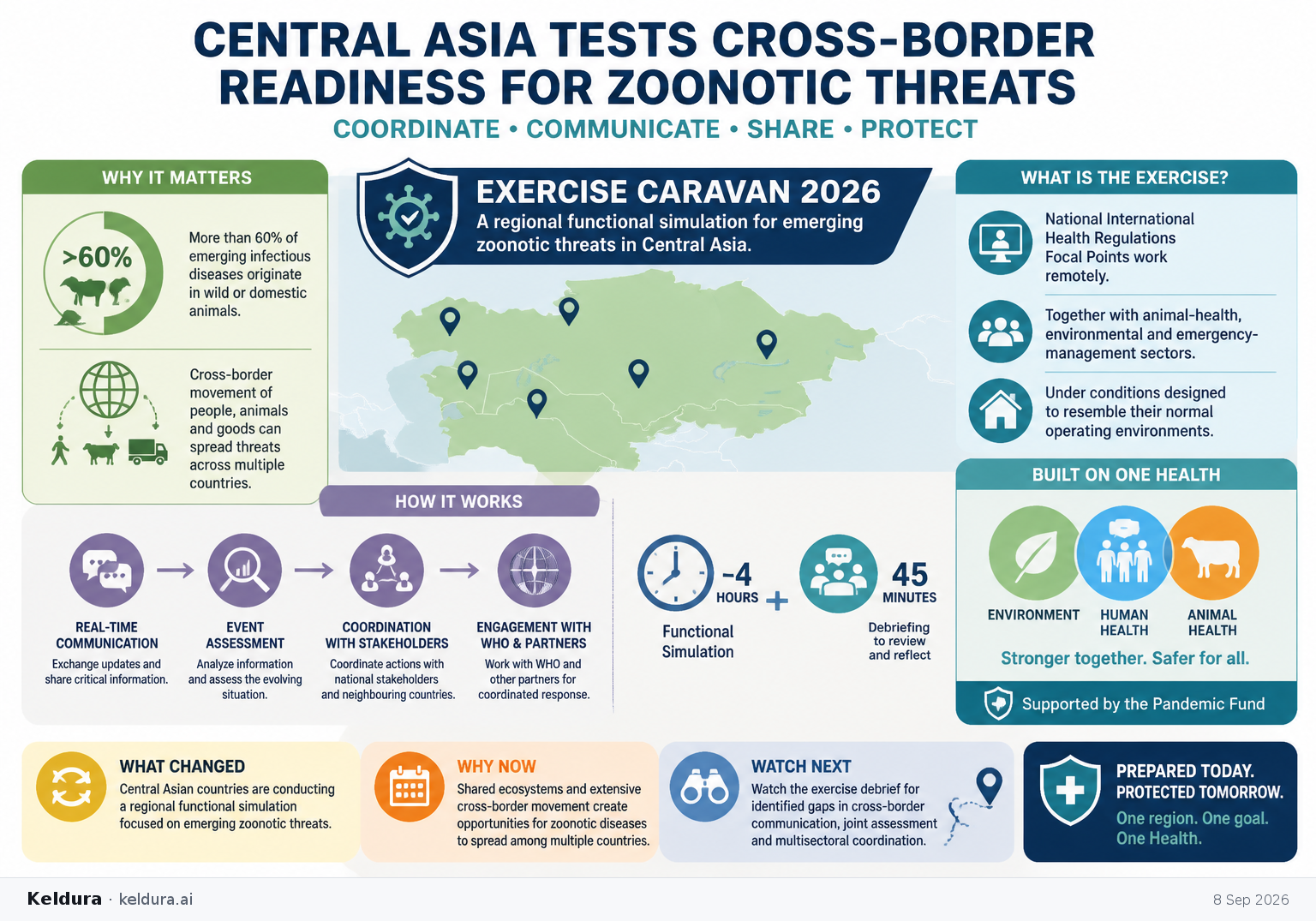
Exercise CARAVAN 2026 will test how Central Asian countries coordinate, communicate and share information during an evolving simulated zoonotic emergency.[1] National International Health Regulations Focal Points will work remotely with animal-health, environmental and emergency-management sectors under conditions designed to resemble their normal operating environments.[1]
Why it matters: More than 60% of reported emerging infectious diseases originate in wild or domestic animals, while Central Asia’s cross-border movement of people, animals and goods can allow health threats to affect several countries simultaneously.[1]
Key insights: The exercise is part of a Pandemic Fund-supported multicountry project advancing the One Health approach.[1] | Participants will simulate real-time communication, event assessment and coordination with national stakeholders, neighbouring countries, WHO and other partners.[1] | The functional exercise will last approximately four hours and be followed by a 45-minute debriefing.[1]
Cheatsheet facts: What changed: Central Asian countries are conducting a regional functional simulation focused on emerging zoonotic threats.[1] | Why now: Shared ecosystems and extensive cross-border movement create opportunities for zoonotic diseases to spread among multiple countries.[1] | Watch next: Watch the exercise debrief for identified gaps in cross-border communication, joint assessment and multisectoral coordination.[1]