NASA shifts mission competitions toward science-first proposals
NASA wants scientists to spend less time preparing mission bids, but when will engineering and cost risks receive scrutiny?
On October 22, 2026, NASA outlined Competition Model 2.0, a staged overhaul of how it solicits and selects science missions.
NASA's Competition Model 2.0 will defer detailed engineering, cost, and implementation work until it is needed, prioritizing the science case in initial proposals. For its accelerated two-step route, NASA says the changes will remove roughly half the initial proposal material and cut the interval f…
Open original · [5] Faster to Science: A Letter to the Science Community - NASA Science — science.nasa.gov
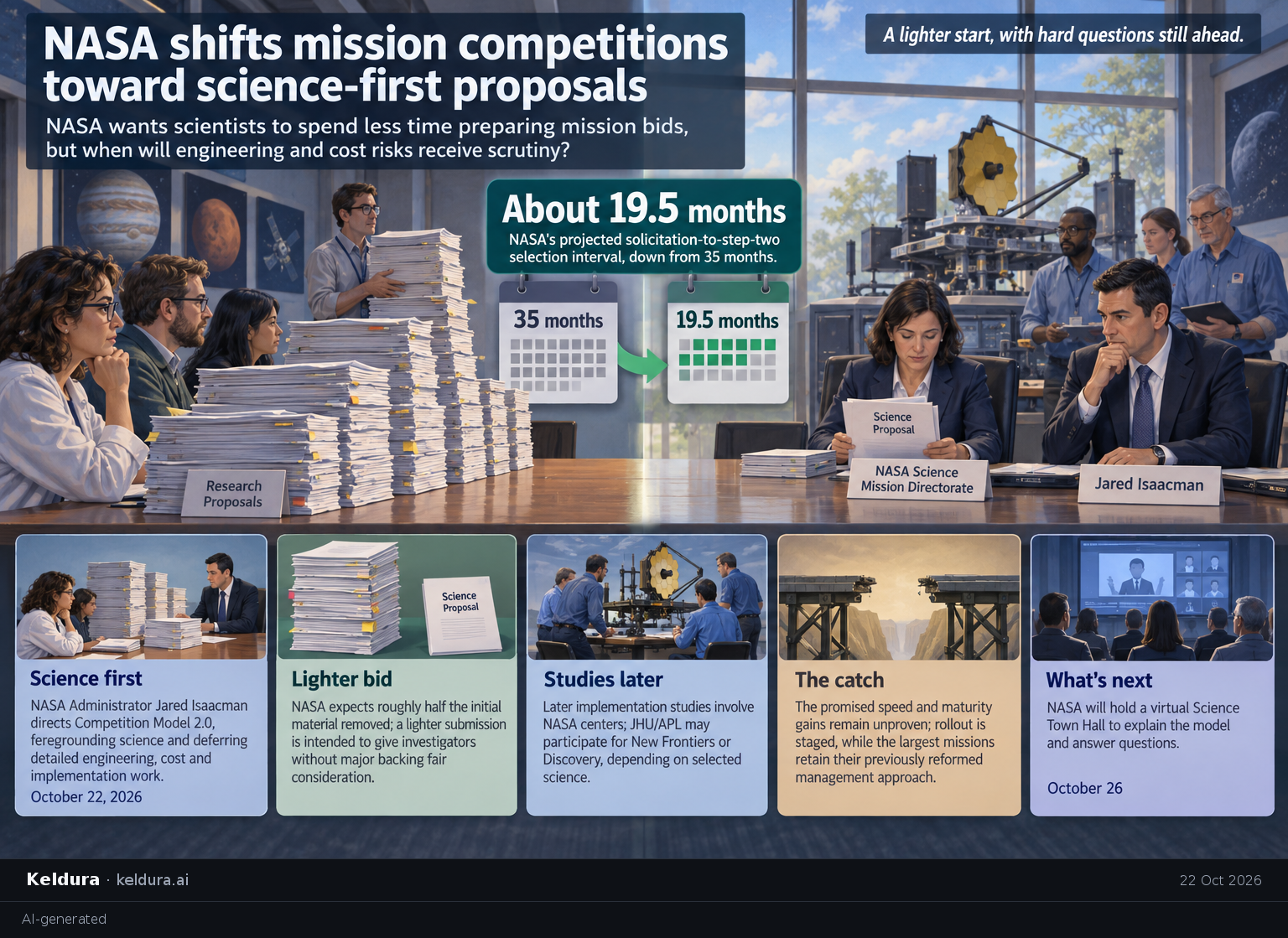
NASA's Competition Model 2.0 will defer detailed engineering, cost, and implementation work until it is needed, prioritizing the science case in initial proposals. For its accelerated two-step route, NASA says the changes will remove roughly half the initial proposal material and cut the interval from solicitation to step-two selection from 35 months to about 19.5 months. [5]
Why it matters: Preparing a mission proposal consumes researchers' time and resources before they know whether their idea will advance. NASA says a lighter initial submission should give investigators without major institutional backing fair consideration, while later implementation studies are intended to expose risks before final selection. [5]
Key insights: The initial submission will ask for a science case, a science implementation plan, and a proof-of-concept mission design—not the full engineering package required later. [5] | For the accelerated two-step route, implementation studies will involve NASA centers, with JHU/APL a possible participant for New Frontiers or Discovery depending on the selected science. [5] | The change is not universal: NASA says its largest missions will retain their previously reformed management approach, and the broader rollout will happen in stages. [5]
Cheatsheet facts: What happened: NASA outlined a science-first competition model that delays detailed engineering, cost, and implementation work until needed for selection. [5] | Why: NASA says the existing process takes years and imposes excessive proposal burdens, contract-management challenges, and uncertainty. [5] | The catch: The shorter timeline is NASA's stated expectation, not a demonstrated result; implementation will be staged, and the largest missions retain their existing approach. [5] | What's next: NASA will hold a virtual Science Town Hall on October 26 to explain Competition Model 2.0 and answer questions. [5]